Your company doesn't have a strategy
I already hear you saying it…
Oh come on Matt. I work at the “Big Widget Company”. Of course they have a strategy! In fact they won’t shut up about it. Every all-hands meeting starts with “This year we have 3 strategic pillars…”
Welp, that may be true, but I’m willing to bet that those “3 pillars” are in no way a strategy (at least not one that has any chance of being successful). I’ve come to find that the term strategy might be the most misused term in the corporate world. Let’s dive into exactly what everyone gets wrong about strategy.
What is a strategy?
The best overall description of strategy that I’ve found is a video with Roger Martin. I’m going to offer a very similar definition here that I find even easier to work with.
A real strategy answers two questions:
- Who are our target customers (and who are not)?
- What are we doing differently than everyone else to win their business?
To illustrate, let’s look at an example of a real strategy: Southwest Airlines (which sadly appears to have backtracked a lot in recent years). Southwest’s target customers were budget conscious travelers looking to fly within the continental United States. These are people who may have otherwise taken a bus or train instead of flying. Importantly, their target did not include business travelers. They conceded that market to American, United, and Delta.
What did they do differently? Basically everything. Since they didn’t care about business travelers, no need for a business class. Prioritizing flights within the continental US meant that they could do a point-to-point model instead of the hub-and-spoke of traditional airlines. No international flights means they really only need one type of plane, a Boeing 737 — which means maintenance and repair operations are simpler. And on and on…
Here are a couple more characteristics that good strategies have:
- It forces you to give up something (customers or capabilities)
- It helps you make decisions
- It’s not easy to replicate
Southwest gave up business travelers to focus on budget conscious consumers. But because of that, they were able to totally dominate that market. As Ron Swanson would say: “Don’t half-ass two things. Whole-ass one thing.”
It also helped them make numerous small and large decisions. “What type of planes should we fly?” Well, since we only need to do domestic flights, we only need 737s. Having only one type of plane streamlines operations immensely. “How should we route flights?” Well, since our travelers are used to taking buses and are only traveling domestically, we should do point to point, not hub and spoke like everyone else.
And Southwest’s strategy is definitely hard to replicate. If Delta wanted to follow suit, they’d have to change their entire flight planning system to go point to point — not an easy task. And if they dropped business class, their high-mileage business travelers would be incensed.
The results speak for themselves. Between 2005 and 2018, Southwest’s domestic market share grew from 7% to 20%.
I bet I can guess your company’s strategy
Does this sound familiar?
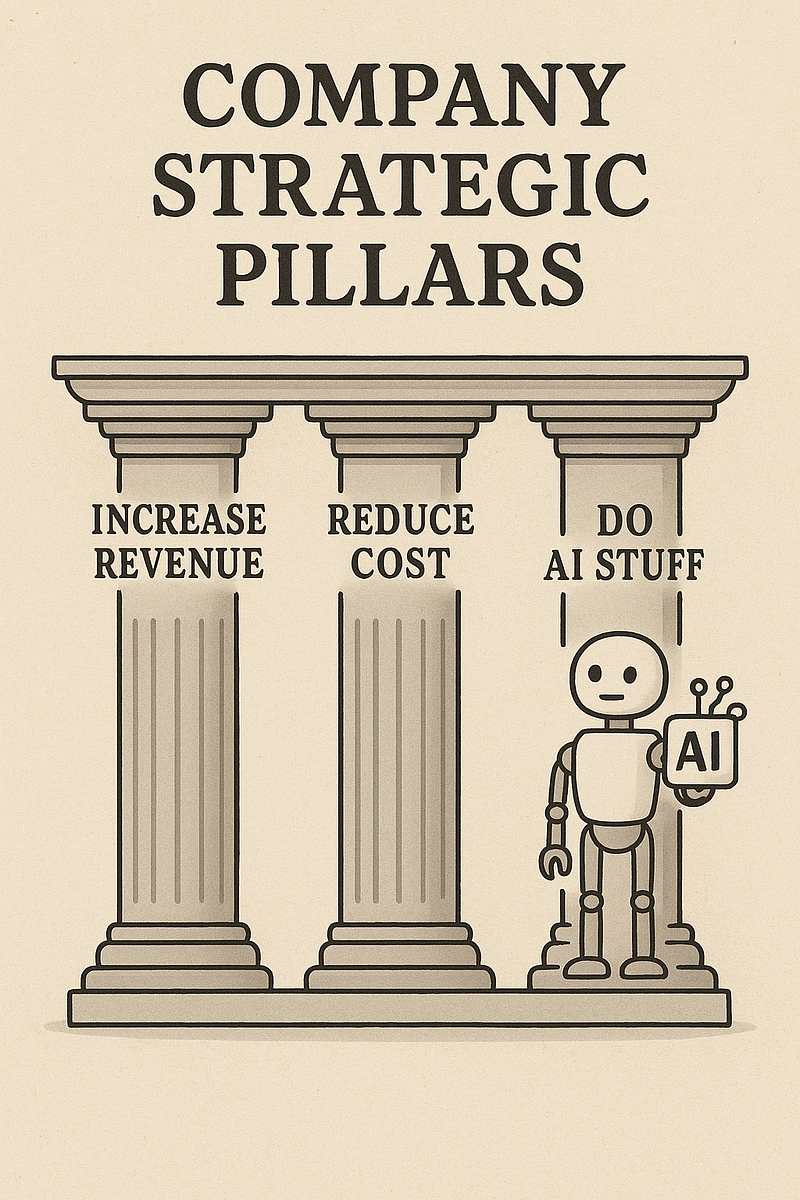
Our 2025 strategy has three pillars:
- Drive growth organically in key business lines.
- Improve operational efficiency at every level.
- Leverage [insert technology, probably AI] to accelerate innovation.
Let’s translate each one into its real meaning:
- Drive growth organically in key business lines = Increase Revenue
- Improve operational efficiency at every level = Decrease Costs
- Leverage AI to accelerate innovation = Everyone is talking about AI. We should probably do … something?
Wow. Truly groundbreaking stuff. If we just increased our revenue, decreased our costs, and something something AI, we’d make more money.
Alright, so obviously this is not a great strategy (or even a strategy at all) — but let’s really break down why this doesn’t make any sense.
The opposite of your strategy should at least be plausible
This is a good litmus test for whether something is actually a strategy. State the logical opposite of the strategy. If no one would ever choose the opposite, you’ve failed the test.
The opposite of “drive organic growth” would be something like “reduce organic growth.” The opposite is complete nonsense — no one would ever choose to grow less. Why does that matter? Because a strategy exists to help you make tough tradeoffs. If you’d never choose the opposite, it’s not helpful.
It’s not differentiated
As far as I know, every company ever strives to make more money, which by definition means either increasing revenue, decreasing costs, or both. This “strategy” doesn’t do anything differently than anyone else.
The customer is absent
So many of these “strategies” focus inward on the company itself. But true strategies focus on the customer and the market. Where are we going to play, and how are we going to win?
The reason most companies focus their strategies inwardly is because it’s easier. As a leader you have at least some level of control over what your company does. But ultimately, you can’t force the market or customers to do what you want. A strategy is inherently a bet with risk — and nobody likes risk.
But unfortunately, someone out there is usually willing to take that risk, and while you’re focused on efficiency, they’re going to eat your lunch.
So … what am I supposed to do exactly?
If you happen to be a founder or someone with actual decision-making power, here’s what I want you to do:
- Evaluate yourself. Do you have a true strategy?
- If the answer is no, STOP. I mean it. STOP EVERYTHING.
If you don’t have a strategy, you are probably wasting SO much time and energy. Take a deep breath, put the next feature on hold, and develop a real strategy. It’s probably the most important thing you could be doing right now.